
What to See on Spinalonga: A Walk Through the Island
Table of Contents
Introduction
Spinalonga is small enough to walk in under two hours, and a single loop takes you past everything worth seeing on the island. A Venetian fortress, an Ottoman town, a leper colony and a cemetery sit layered on one another. What to see on Spinalonga is, in effect, roughly 400 years of history compressed into a few hundred metres of stone.
The island once guarded the entrance to the ancient harbour of Olous, now partly sunk off nearby Elounda. The clockwise visitor path passes the monuments in the order below, from the tunnel to the tombs.
The tunnel, known as Dante’s Gate
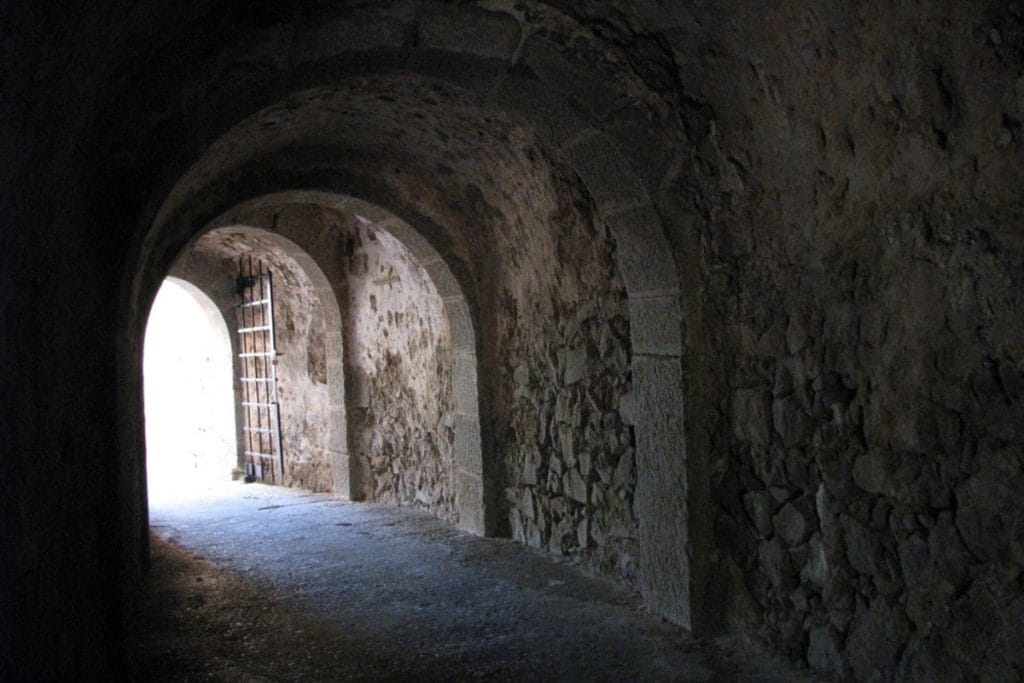
The visit starts at a vaulted stone passage about 20 metres long, known as Dante’s Gate. The name comes from the line in Dante’s Inferno, “Abandon all hope, you who enter here,” because patients arriving at the colony could not see what waited beyond. Walking through it today is the same first step every resident once took.
The Spinalonga fortress, built in 1579
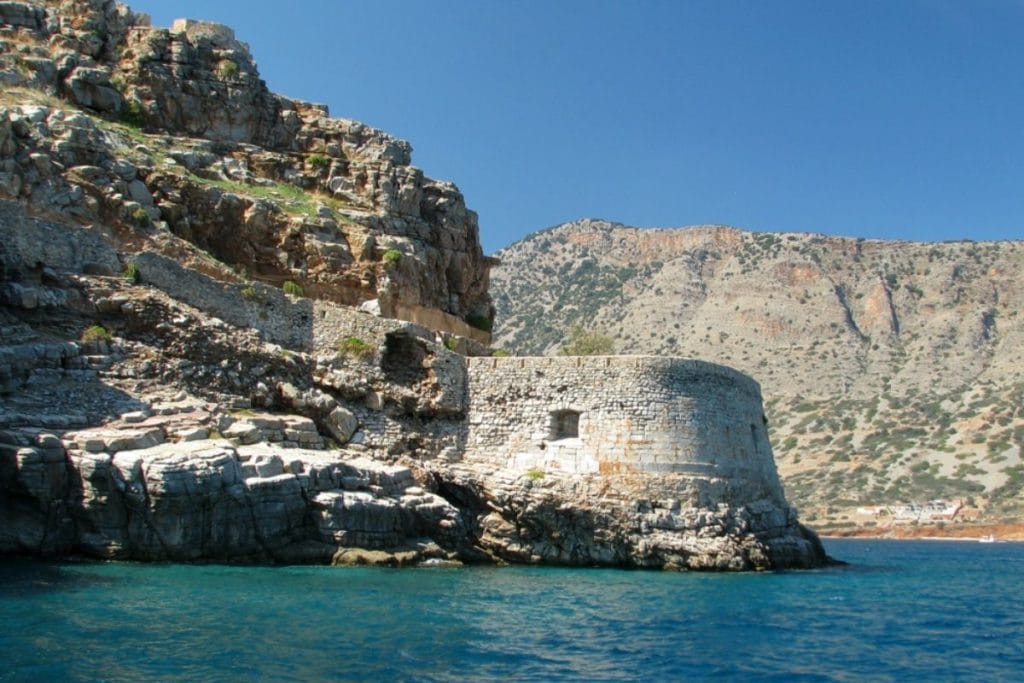
Above the entrance rises the fortress the Venetians began in 1579, one of the strongest seaward forts in the Mediterranean. The engineer Genese Bressani was commissioned to design it in 1578, with blockhouses on the high points to the north and south, and the foundation stone was laid in 1579 by Luca Michiel, the Venetian governor of Crete. The Michiel and Moceniga demilunes, two half-moon artillery works, still stand, along with a carved Lion of Saint Mark and the date 1579 cut into the stone.
The fort was built to be impregnable, and for a long time it was. It held for 136 years and fell to the Ottomans only in 1715, some 46 years after Heraklion surrendered in 1669. Its walls still frame the whole seaward side of the island.
The Ottoman town of Spinalonga
After 1715 an Ottoman settlement grew over the Venetian foundations and thrived through the 19th century. By 1881 it held 1,112 people and was the largest Muslim commercial centre of Mirabello Bay, according to the island’s UNESCO listing. The two-storey houses and old shops along the main street are strong examples of Balkan vernacular architecture, and they are the same buildings the leper colony reused as homes after 1903.
What to see on Spinalonga: the main street and museum
The main street runs through the heart of the former colony, past whitewashed houses, a small square and the shops that once served the community. A perimeter road was opened around the island in the late 1930s, when part of the old wall was taken down so residents could walk more freely. Much of what to see on Spinalonga sits along this street, where several houses have been restored by the Ephorate of Antiquities of Lasithi into a small museum of photographs and everyday objects.
The church of Agios Panteleimon
At the centre of the settlement stands the church of Agios Panteleimon, which dates to 1709 and was restored by the patients, who attended mass, married and baptised their children there. It gave its name to the residents’ own association and remained the focus of island life until the colony closed. A second, older church, Agios Nikolaos, stands higher up the island near the former hospital.
The disinfection room
Near the exit stands the disinfection room, a small building that marked the border between the colony and the outside world. Visitors who came to the island had their hands washed with alcohol here before they were allowed to leave. It is one of the clearest reminders of how the healthy and the sick were kept apart.
The Spinalonga cemetery and ossuary
The path ends at the cemetery, built over the 16th-century Donato bastion. Stone and concrete tombs lie open, and inside a low stone tower, the ossuary, the bones of more than 400 patients remain visible. A plaque at the entrance asks visitors to respect the people buried here.
Water and the island’s isolation
Spinalonga has no water source of its own. The Venetian garrison, and later the colony, relied on rainwater stored in cisterns and on boats bringing supplies from the mainland. Patients bought produce from boats that tied up at the dock each day, and food that went unsold could not be carried back ashore, so it was thrown into the sea as contaminated.
The two gates and the perimeter path
The island had two entrances. One was Dante’s Gate, the tunnel the patients passed through, and the other, by a small pebbled beach, was where boats delivered food and supplies. A path now circles the whole island, following the road opened in the late 1930s, when part of the wall was removed to give residents more room to move.
The views from the walls
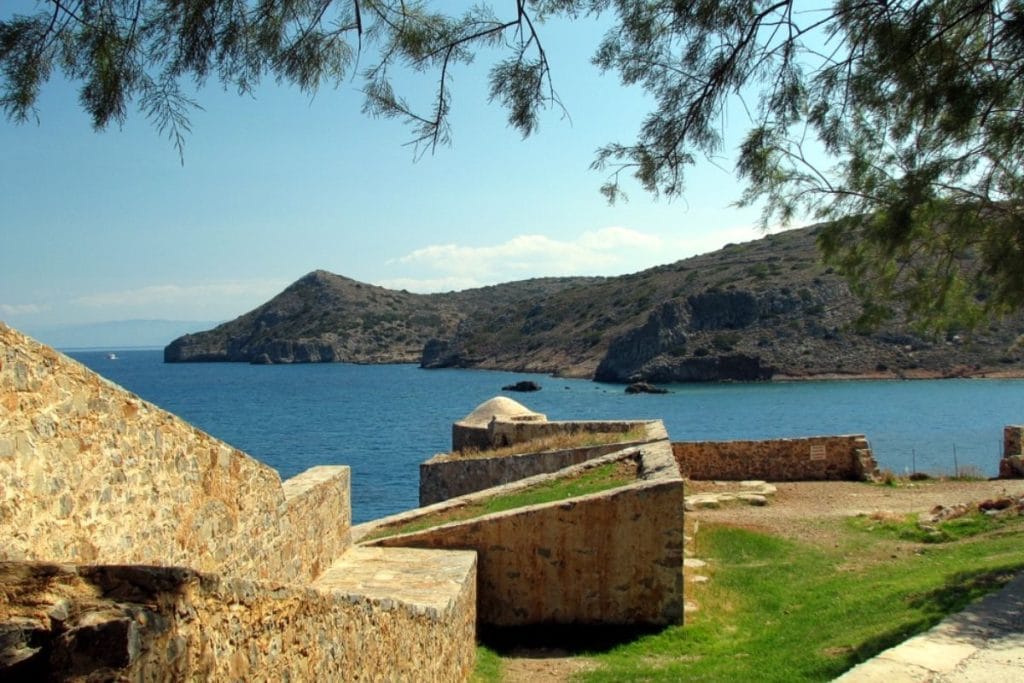
From the higher ground the walls look back across the water to Plaka and Elounda, with the Kolokytha peninsula to the south and the mountains of Lasithi beyond. The position that once made the fort easy to defend now gives some of the widest sea views in eastern Crete.
That single loop is what to see on Spinalonga, and it returns you to the jetty with wide views across the Gulf of Elounda toward Plaka. Wear sturdy shoes and carry water, because the ground is uneven and there is no shade or shop along the way.